






Working Principle and Advantages of Electric Press Brake
Why Electric Press Brakes Are Becoming the New Industry Standard
In recent years, sheet metal fabrication has entered a phase where traditional solutions no longer meet emerging production demands. Customers expect tighter tolerances, faster delivery, lower energy consumption, and more environmentally responsible manufacturing. At the same time, manufacturers are facing rising labor costs, stricter safety regulations, and increasing pressure to digitize their production lines.
Against this background, the electric press brake has evolved from a niche solution into a practical alternative to hydraulic bending machines. Unlike hydraulic press brakes, which rely on oil pressure, valves, and complex fluid control, electric press brakes convert electrical energy directly into controlled mechanical motion through servo motors and precision transmission components.
Among different technical approaches, the direct-drive all-electric press brake stands out for its simplicity, stability, and long-term reliability. By eliminating hydraulic systems and synchronous belt mechanisms, this architecture fundamentally changes how bending force, motion accuracy, and safety are achieved.
This article explains the working principle of direct-drive electric press brakes, their control logic, and the practical advantages they offer in precision manufacturing, energy efficiency, maintenance, and intelligent production environments.

1. Mechanical Structure and Working Principle of a Direct-Drive Electric Press Brake
1.1 Simplified Mechanical Architecture Built for Stability
The core of a modern electric press brake is its drive system. In a direct-drive configuration, the servo motor, reduction gearbox, and heavy-duty ball screw are connected in a straight, coaxial line. This design removes the need for traditional synchronous pulleys and belts, which are common sources of vibration, noise, wear, and unexpected failure.
When the servo motor rotates, torque is transmitted directly to the reduction gearbox, which increases output torque while maintaining precise speed control. The gearbox then drives the ball screw, converting rotational motion into linear movement through the ball nut. This linear motion moves the ram vertically, carrying the upper tool to perform the bending operation.
Because power transmission is direct and continuous, mechanical losses are minimized. The result is a highly efficient motion system with fast response, stable force output, and excellent repeat positioning accuracy.
1.2 Gravity Balancing Without Brake Motors
One of the key engineering challenges in electric press brake design is managing the weight of the ram. In conventional solutions, brake motors or mechanical locking systems are used to prevent the ram from dropping when power is removed. These components add cost, complexity, and potential accuracy loss.
In a direct-drive electric press brake, this issue is addressed through a magnetic damping balancing system that counteracts the gravitational force of the ram. By balancing the load mechanically, the servo motor no longer requires a holding brake.
This approach simplifies the structure, reduces energy consumption, and improves positioning stability. Without brake engagement or release, the ram responds more smoothly to servo commands, contributing to consistent bending angles and reduced mechanical wear.
1.3 Backlash Elimination for High Repeatability
High-precision bending depends not only on positioning accuracy but also on repeatability over long production cycles. In direct-drive electric press brakes, backlash is eliminated through preloaded thrust bearings and locking nut assemblies.
By preloading the thrust bearings, axial clearance in the ball screw system is removed. This ensures that the ram follows servo commands immediately, without delay or reverse motion play. As a result, the machine maintains stable bending accuracy even after extended operation, avoiding the cumulative errors often seen in belt-driven or hydraulic systems.

2. Control System Architecture and Motion Logic
2.1 Embedded Human–Machine Interface
The control system of an electric press brake typically consists of an embedded industrial controller combined with a numerical control (NC) motion framework. The embedded unit is based on an ARM processor and integrates a touchscreen interface for daily operation.
Running on a Linux operating system, the embedded controller hosts the human–machine interface software used for part programming, parameter setting, tool management, and machine diagnostics. This separation between user interaction and motion execution improves system stability and reduces the risk of control delays during operation.
2.2 Dedicated High-Speed Motion Control Module
Real-time motion control is handled by a dedicated NC module equipped with a high-performance DSP processor. This processor is optimized for multi-axis motion control and high floating-point precision, allowing accurate interpolation and synchronization of servo movements.
The NC module supports linear displacement sensor inputs, analog and digital I/O interfaces, and industrial communication protocols such as RS485. This configuration enables precise feedback processing and stable control even during high-speed bending cycles.
2.3 From Program to Motion: Control Workflow
During operation, the operator creates a bending program on the embedded interface based on the sheet metal drawing and required process parameters. The system converts this information into G-code instructions and transmits them to the NC motion controller via an internal network.
The NC controller interprets the G-code and controls the servo systems using a pulse-and-direction mode. During the bending stroke, servo torque is regulated in real time according to material thickness, bending length, and target angle. This allows the ram to deliver only the required force, avoiding unnecessary stress on tools and machine components.
Unlike hydraulic systems, where force control is influenced by oil compressibility and temperature fluctuations, electric press brakes provide direct, predictable force output through servo torque control.

3. Direct-Drive Electric Press Brakes Compared with Traditional Transmission Systems
Traditional electric press brakes often rely on synchronous belts to transmit motion from the motor to the screw. While functional, these systems introduce additional components that require adjustment, maintenance, and periodic replacement.
In contrast, direct-drive systems offer a more robust solution. The elimination of belts reduces assembly complexity and removes the risk of belt breakage, which can cause uncontrolled ram movement in extreme cases. This significantly improves operational safety.
Noise levels are also lower. Without belt vibration, hydraulic pumps, or fluid flow noise, direct-drive electric press brakes typically operate below 75 dB. This creates a more comfortable working environment and helps manufacturers comply with workplace noise regulations.
High-speed servo motors, often rated up to 4000 rpm, enable faster approach and return speeds. Combined with absolute encoders, these motors allow the machine to retain position information after power-off, eliminating the need for homing procedures during startup.

4. Practical Advantages of Electric Press Brakes in Production Environments
4.1 Precision and Repeatability for High-Value Applications
Electric press brakes achieve positioning accuracy as high as ±0.01 mm due to ball screw transmission and servo control. This level of precision is essential in industries such as electronics, new energy equipment, and medical devices, where dimensional consistency is critical.
Angle control is equally precise. With real-time torque adjustment and optional laser angle measurement systems, angle deviations can be kept within ±0.5 degrees. In comparison, hydraulic press brakes often experience angle variations of ±1 to ±2 degrees due to oil compression and temperature changes.
For long workpieces, multi-axis servo synchronization ensures uniform bending across the entire length, preventing common defects such as end lifting or uneven angles.
4.2 Energy Efficiency and Environmental Performance
Electric press brakes consume power only during active motion. When idle, energy consumption is close to zero. Hydraulic press brakes, by contrast, require continuous pump operation, resulting in significantly higher energy usage.
In practical terms, electric press brakes can reduce energy consumption by 40–60% per bending cycle. The absence of hydraulic oil also eliminates the risk of leaks, reduces waste, and simplifies environmental compliance.
4.3 Productivity and Flexibility
High approach speeds, fast servo response, and quick program switching make electric press brakes well suited for high-mix, low-volume production. Non-productive time is reduced, and operators can switch between different parts with minimal setup.
With modern CNC systems, hundreds of bending programs can be stored and recalled instantly. When combined with quick-change tooling systems, changeover times can be reduced from tens of minutes to just a few minutes.
4.4 Reduced Maintenance and Long Service Life
By eliminating hydraulic cylinders, valves, seals, and oil circuits, electric press brakes significantly reduce maintenance requirements. Key components such as ball screws and linear guides have long service lives and require only periodic lubrication.
Maintenance intervals are extended, downtime is reduced, and overall equipment availability is improved. Over the machine’s lifecycle, this results in a lower total cost of ownership compared with hydraulic alternatives.
4.5 Compatibility with Intelligent Manufacturing Systems
Electric press brakes are inherently compatible with Industry 4.0 concepts. Their digital control systems support data collection, production monitoring, and integration with MES or ERP systems.
Remote diagnostics, predictive maintenance, and software updates allow manufacturers to optimize machine performance continuously. Optional laser angle detection enables automatic compensation for material springback, reducing operator dependence and improving consistency.

Conclusion: A Technology Shift Driven by Manufacturing Reality
The move from hydraulic to electric press brakes reflects a broader shift toward precision, efficiency, and sustainability in manufacturing. Direct-drive all-electric press brake technology addresses long-standing challenges in bending accuracy, energy consumption, maintenance, and safety.
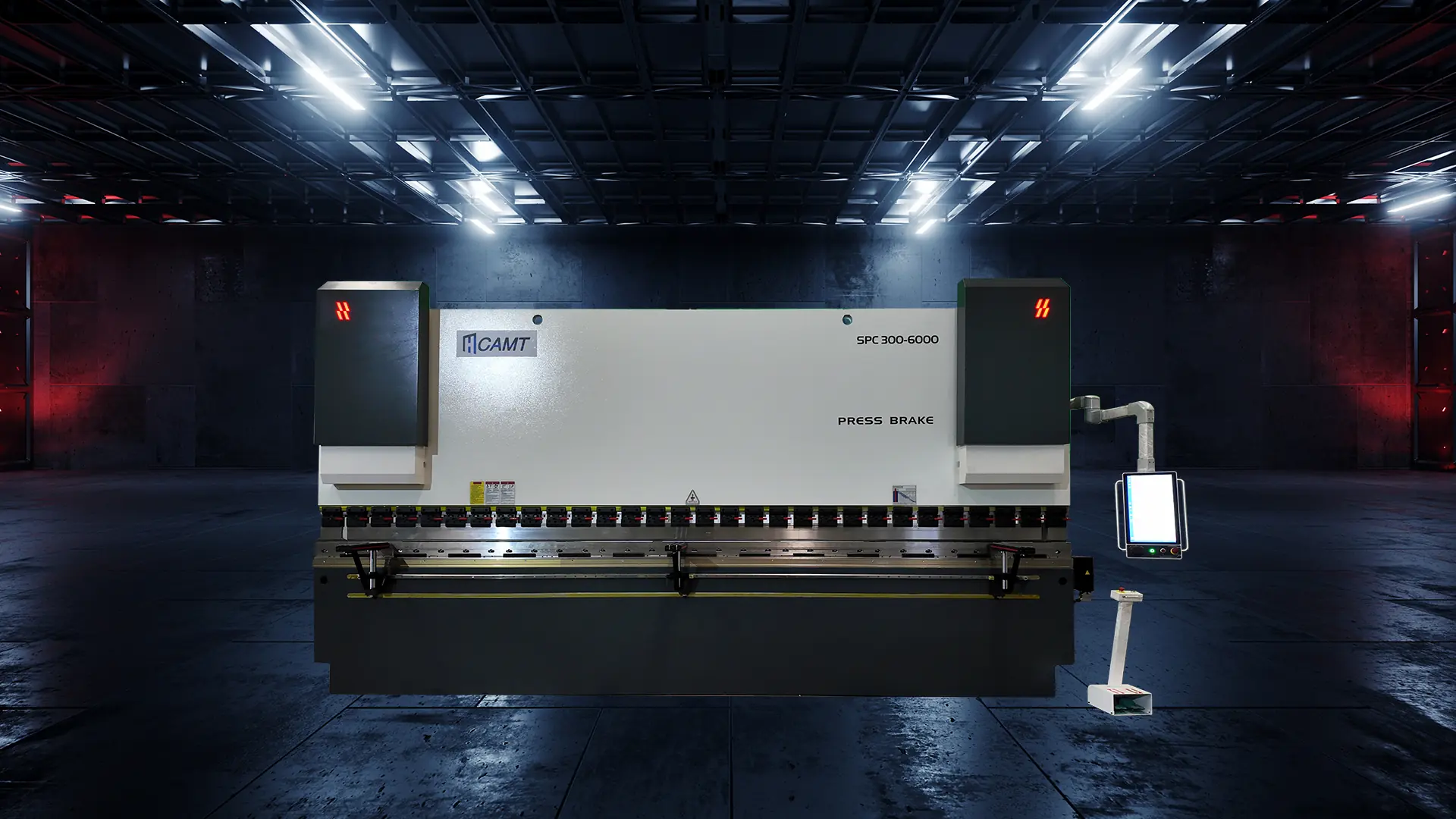
This architecture is no longer experimental. It has been validated in real production environments and adopted by machine builders such as CAMT, where direct-drive electric press brakes are already operating reliably in continuous industrial use. These implementations demonstrate that electric press brakes are not just theoretically superior, but practically proven.
For manufacturers seeking stable accuracy, lower operating costs, and readiness for intelligent production, electric press brakes represent a clear and forward-looking solution.
FAQ – Electric Press Brake Technology
What is an electric press brake?
An electric press brake uses servo motors and precision mechanical transmission instead of hydraulic oil to perform bending operations, offering higher accuracy and energy efficie
Are electric press brakes suitable for industrial production?
Yes. Modern direct-drive designs have been validated in continuous production environments and can handle demanding bending tasks with stable performance.
How do electric press brakes reduce maintenance costs?
They eliminate hydraulic components such as pumps, valves, and seals, reducing wear parts and extending maintenance intervals.
Do electric press brakes consume less energy?
Yes. Energy is consumed only during active bending motion, resulting in significant savings compared with hydraulic machines.
Can electric press brakes integrate with smart factory systems?
Yes. They support digital connectivity, data monitoring, remote diagnostics, and software updates for Industry 4.0 applications.

Metalworking specialist with 12 years of experience in sheet metal fabrication and press brake applications, certified by ASME.