






Conclusion
meet rigorous safety and performance standards. Engineers and manufacturers can leverage these techniques to design robust, cost-effective CNC press brakes that meet modern industry demands.
Jane Smith.
Metalworking specialist with 12 years of experience in sheet metal fabrication and press brake applications, certified by ASME.
- All ProductsV-Grooving Machine.
- Punchine MachineRelated News.
- How to Properly Install a Press Brake MachinePress Brake Safety Precautions: Complete Guide for Safe Operation and Maintenance.
blog
press brake frame
- press brake machinepress brake safety.
- Mesh Statistics: The final model comprises 216,177 elements and 354,961 nodes.
- 2.2 Benefits of Meshing StrategyAccuracy.
: The use of high-precision.
elements ensures reliable simulation of stress and deformation in the press brake machine body.
Efficiency.
: Automated meshing with smart size control optimizes computational resources, making the process scalable for industrial applications.
- User Value: This methodology provides engineers with a repeatable, high-fidelity approach to FEA, addressing the need for accurate structural analysis.
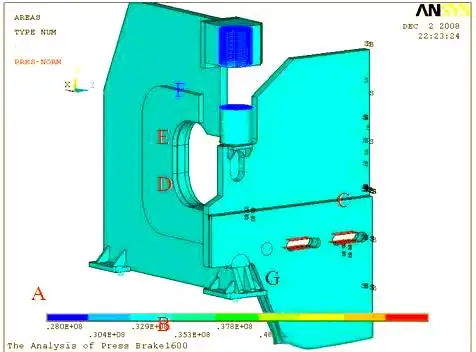
- 3. Constraints and Load ApplicationAccurate modeling of constraints and loads is essential to simulate the real-world operating conditions of a CNC press brake.
- 3.1 Constraint AnalysisBase Constraints : The press brake’s base is fixed to the ground, restricting movement in the x, y, and z directions to reflect its anchored state. Side Plate Constraints.
- : The front and rear side plates, bolted to the main working plate, are constrained in the x-direction to simplify the model while maintaining accuracy.3.2 Load Application.
Hydraulic Cylinder Loads
- : The left and right side plates experience a maximum uniform pressure of 28 MPa from hydraulic cylinders, applied to the cylinder base and inner walls.Compensation Cylinder Loads : The press brake’s base is fixed to the ground, restricting movement in the x, y, and z directions to reflect its anchored state. Worktable Loads.
- : Based on force balance principles, the worktable’s upper surface withstands a maximum pressure of 7.9 MPa. Additional uniform pressures of 54 MPa and 60 MPa are applied to the worktable and side plate surfaces in contact with the compensation cylinder.3.3 Practical Implications.
- These constraints and loads accurately replicate the operational environment of a hydraulic press brake, enabling precise analysis of stress and deformation. This addresses user needs for reliable simulation data to inform design decisions.4. Structural Optimization and Result Analysis.
Finite element analysis provides critical insights into the press brake frame’s performance, guiding targeted optimization to enhance efficiency and safety.
4.1 Stress and Deformation Findings.
Stress Concentrations
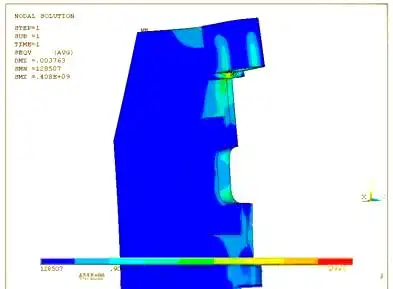
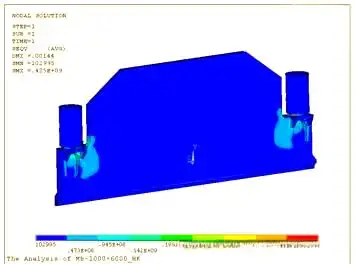
- : Initial analysis reveals high stress near direct load points, such as hydraulic cylinder connections, while most of the frame exhibits significant strength reserves.Stiffness Performance.
- : The press brake frame demonstrates excellent stiffness, providing ample opportunity for material optimization without compromising structural integrity.4.2 Optimization Strategies.
Thickness Reduction
- : Non-critical plates are thinned to reduce material usage, lowering production costs.Reinforcement of Key Areas.
- : Load-bearing regions, such as the throat and key connections, are strengthened to mitigate stress concentrations.Safety Validation.
- : Post-optimization, finite element calculations confirm that the design meets safety standards. Stress cloud diagrams for the optimized frame and slider.4.3 Optimization Benefits.
Improved Stress Distribution
: The optimized frame achieves uniform stress distribution, reducing the risk of localized failure.
Material Savings
: Thinner plates in non-critical areas reduce material costs while maintaining performance.
Enhanced Safety
- : Rigorous safety checks ensure the optimized design withstands operational loads, addressing user concerns about reliability.5. Practical Applications and Industry Impact.
- The optimized press brake design offers significant benefits for manufacturers and end-users:Cost Efficiency.
: Reduced material usage lowers production costs, making CNC press brakes more competitive.
- Performance Enhancement: Uniform stress distribution and reinforced key areas improve durability and operational reliability.
- Scalability: The FEA methodology is adaptable to various press brake models, supporting innovation across the industry.
- Finite element analysis and structural optimization of press brake frames enable manufacturers to achieve superior performance and cost efficiency. By simplifying models, employing advanced meshing, accurately defining constraints and loads, and optimizing critical components, this approach ensures thathydraulic press brakes.
meet rigorous safety and performance standards. Engineers and manufacturers can leverage these techniques to design robust, cost-effective CNC press brakes that meet modern industry demands.
- Read more about Principle and Function of Press Brake Safety Protection SystemRead more about Press Brake Maintenance and Repair.
- Read more about Practical Methods for Press Brake Accuracy with Long Term PrecisionRead more about Practical Guidance For Press Brake Operation.
- Read more about How to Properly Install a Press Brake Machinepress brake frame.
press brake safety
The optimized press brake design offers significant benefits for manufacturers and end-users:
- Cost Efficiency: Reduced material usage lowers production costs, making CNC press brakes more competitive.
- Performance Enhancement: Uniform stress distribution and reinforced key areas improve durability and operational reliability.
- Scalability: The FEA methodology is adaptable to various press brake models, supporting innovation across the industry.
Press brake maintenance and repair should be viewed as an ongoing process rather than a reaction to failure. Proper lubrication, careful hydraulic system management, and regular mechanical inspection form the foundation of reliable machine operation. These practices not only reduce downtime but also help maintain consistent bending accuracy over the machine’s service life.
Finite element analysis and structural optimization of press brake frames enable manufacturers to achieve superior performance and cost efficiency. By simplifying models, employing advanced meshing, accurately defining constraints and loads, and optimizing critical components, this approach ensures that hydraulic press brakes meet rigorous safety and performance standards. Engineers and manufacturers can leverage these techniques to design robust, cost-effective CNC press brakes that meet modern industry demands.

V-Grooving Machine
- Press Brake
- Laser Cutting Machine
- Shearing Machine
- Press Brake Safety Precautions: Complete Guide for Safe Operation and Maintenance
- Hydraulic Press Machine
- Read more about Practical Methods for Press Brake Accuracy with Long Term Precision
- Rolling Machine
- Ironworker
- Press Brake Tooling
- Machinery Accessories