







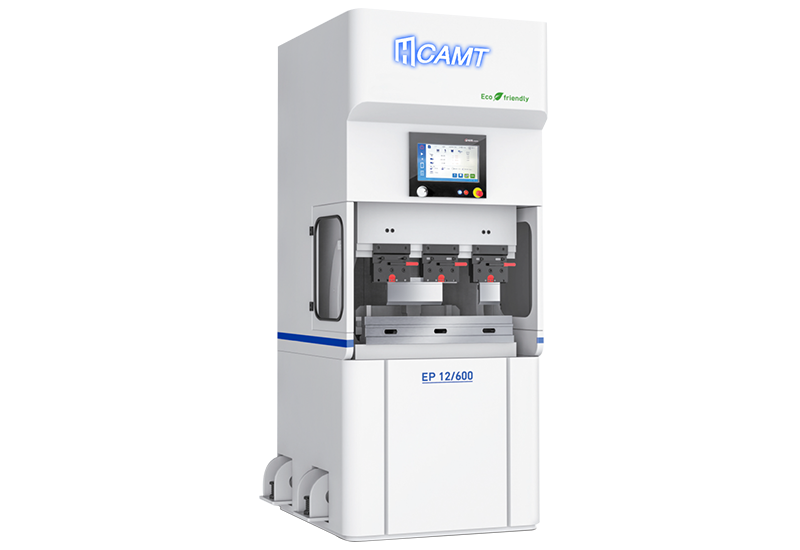
Efficiency Servo Electric Press Brake EPB Series

CAMT full servo electric press brake operates on a sophisticated principle where servo motors, controlled by an advanced CNC system, drive the ram’s movement to execute precise bending tasks, eliminating the need for hydraulic oil used in traditional machines. The CNC system processes programmed parameters such as bending angles and lengths, while real-time sensor feedback ensures exceptional accuracy down to ±0.005mm, making it ideal for intricate metalworking applications. Its advantages are numerous: it offers superior energy efficiency and environmental sustainability by avoiding hydraulic systems, thus reducing energy consumption and eliminating oil-related pollution. The machine also boasts high-speed performance with rapid response times, significantly shortening bending cycles and boosting overall productivity. Maintenance is minimal due to the absence of hydraulic components, which lowers operational costs and enhances equipment longevity. Furthermore, its flexible CNC programming enables seamless transitions between different workpiece specifications, catering to diverse production needs with ease, making it a versatile and cost-effective solution for modern manufacturing.
CAMT Full-Servo Electric Press Brake EPB Series
Stable&Durable.
Long Service Life Time
breadcrumbs
crowning system
crowning system
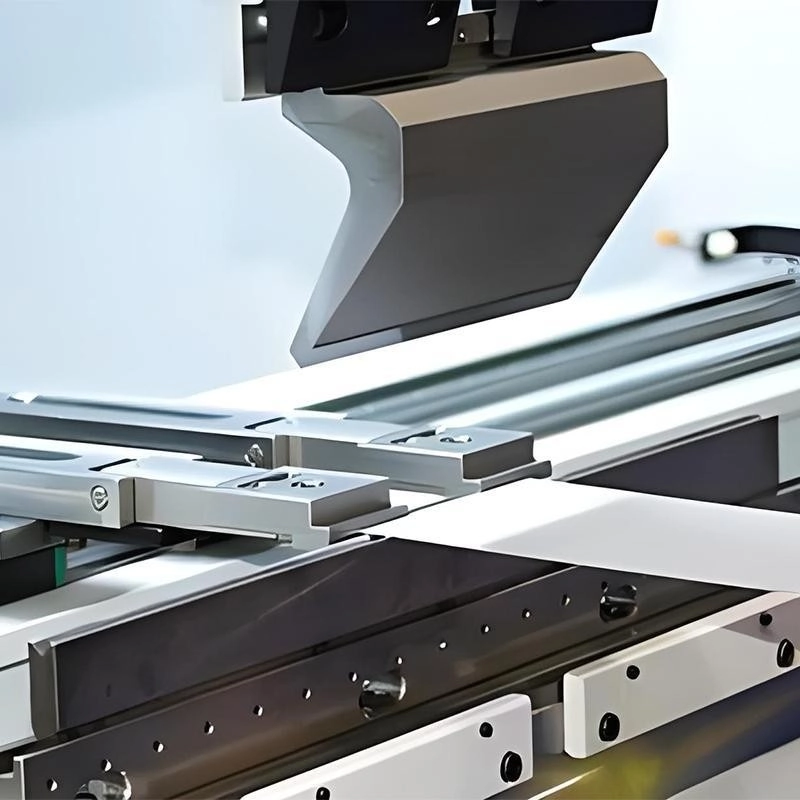
CHTR Rear BGA 600MM with 300MM/S
2 V Double CNC die series &835mm punches
VICHI Full Servo Motor&Drive
Imported Italy GIVI Maganetic Misure
Taiwan Precise HIWIN/TBI Ball Screw & LinearGuide
- Safety France Schneider Electric System Components
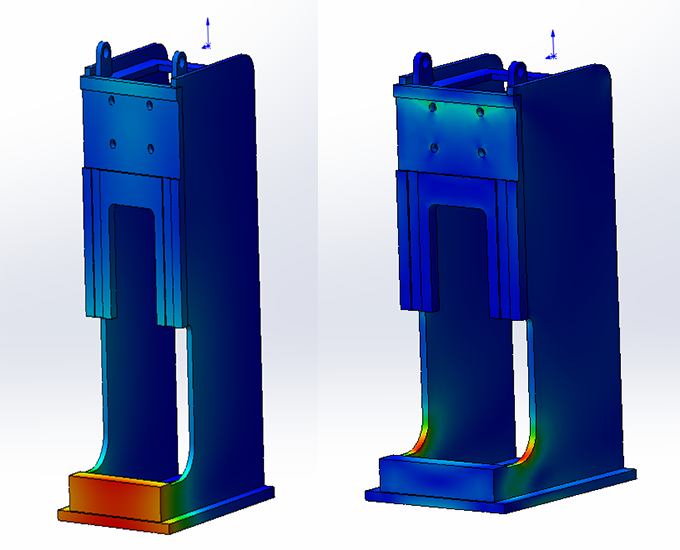
- FEA & Stress Analysis of Small Press Brake
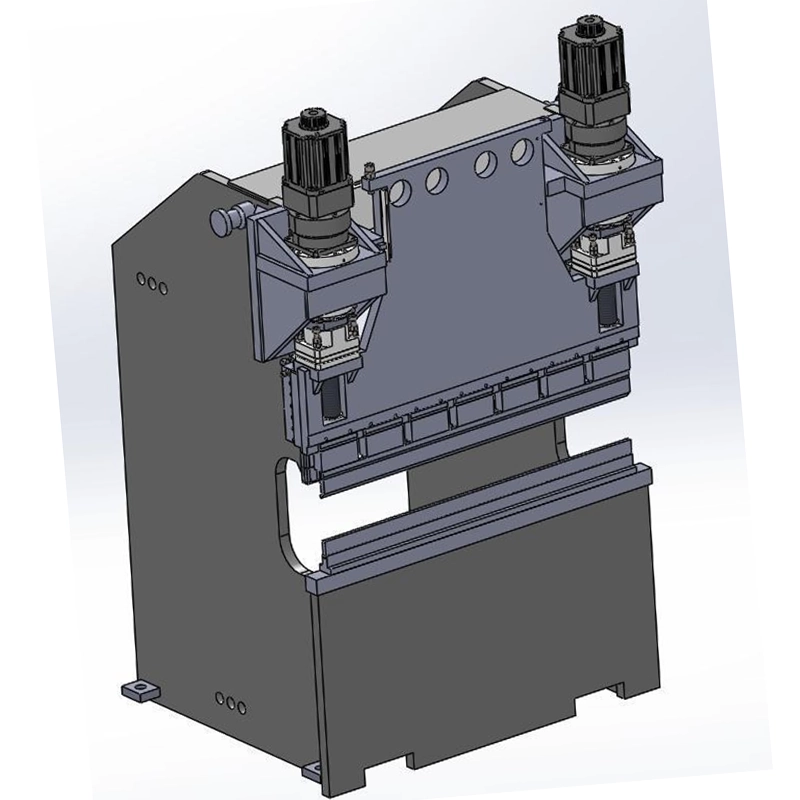
- CAMT evaluate its structural integrity, performance, and efficiency under operational loads. The analysis focuses on key components, including the frame, bending arm, and drive system, modeled using 3D finite element methods. Material properties, such as steel for the frame and high-strength alloys for moving parts, are defined to ensure accuracy. Boundary conditions simulate real-world loading scenarios, including maximum bending forces and torque from the electric motor. The FEA assesses stress distribution, deformation, and fatigue life to identify potential failure points. Results indicate that the machine’s design meets safety and performance requirements, with optimized stiffness and minimal deflection under load. Recommendations for improving structural efficiency and reducing material usage are provided based on the analysis. This study demonstrates the effectiveness of FEA in enhancing the design and reliability of pure electric bending machines.
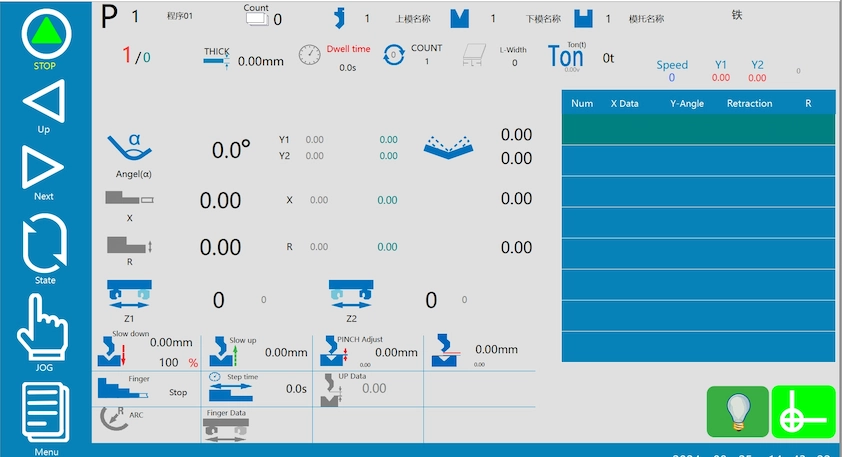
- The system supports 4-axis control, meeting the highest control conditions of 4+2 axis bending machine
- VICHI Servo Drive Theory
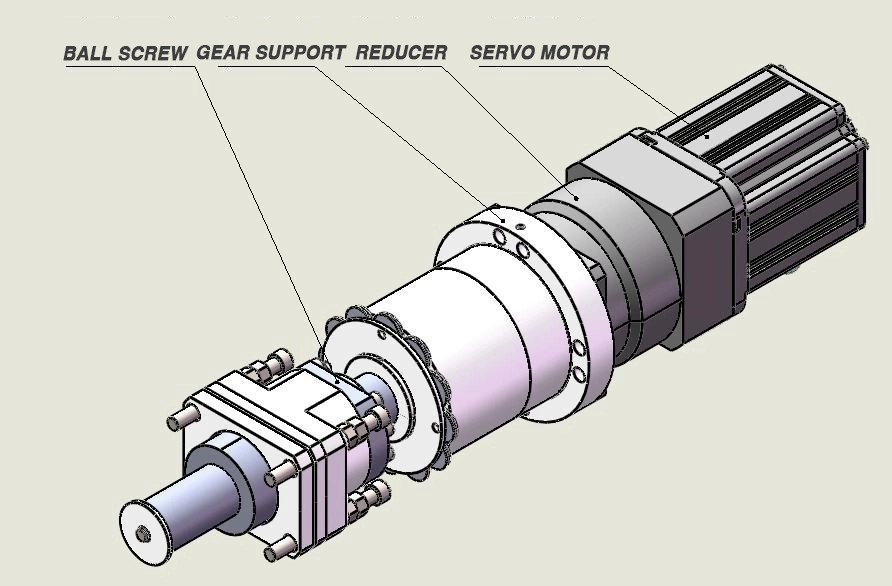
- Servo Pure Press Brake Direcly Drive-Structure &Principle
- The innovative design of a direct-connected all-electric servo press brake integrates a servo motor, reducer, and heavy-duty lead screw in a streamlined configuration, eliminating the synchronous pulley mechanism. This approach resolves issues associated with synchronous pulley systems, such as high noise levels and safety concerns due to belt breakage. The new design offers low noise, minimal repeat positioning error, a simple and reliable structure, and reduced costs.
- In this system, the servo motor directly drives the reducer and lead screw, enabling rotational motion. The lead screw nut, driven by the screw’s rotation, moves vertically, actuating the slider. The slider, in turn, drives the upper mold to perform vertical movements, facilitating precise sheet metal bending. This direct-connection mechanism enhances operational efficiency, reliability, and precision while maintaining a cost-effective and compact design, making it an ideal solution for modern sheet metal processing.
Direct-Connect Design
FEA accurately predicts stress distribution patterns, deformation characteristics, and load-bearing capacities under various operating conditions. This advanced analytical approach enables engineers to identify and reinforce potential weak points in the frame, ram, and bed assembly while optimizing material usage through topology optimization techniques. The analysis specifically targets critical performance factors including ram deflection compensation accuracy, structural vibration damping, and fatigue resistance under cyclic loading conditions. Through iterative simulation processes, FEA facilitates the development of press brakes with enhanced rigidity-to-weight ratios, improved energy efficiency, and prolonged service life.
Compared to synchronous belt systems, the direct-connected design is easier to assemble and more reliable.
Tandem machine management(option, can up to 4 machines)
ESA S650W 2D Graphical CNC System
- No limit in both performances and flexibility.
- "The powerful built-in Pc allows having on the machine a real 3D cad cam (metallix, radan, esa)
- he servo motor is equipped with an absolute encoder, eliminating the need to search for the zero position upon startup
- Direct import of tools shapes (.dxf files) and management of tool library.
- Tool and die holders management.
- Angle measurement and correction with all existing devices is available.
Unlike hydraulic systems, which require regular oil changes and are prone to pump, valve, and seal failures, pure electric bending machines feature a simple transmission system with minimal maintenance needs, typically limited to periodic lubrication
Product Feature:
INOVANCE Servo Motors & Drivers for Fiber Laser Cutter
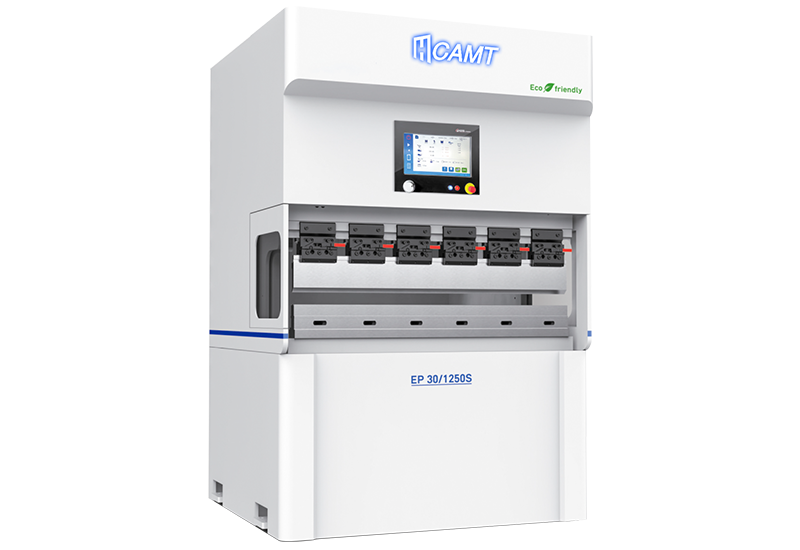
CAMT developed to meet market demands, featuring powerful functionality, rich built-in resources, and characteristics of safety, efficiency, energy savings, and environmental friendliness.
Advanced sheet metal bending and motion control algorithms, with the mainboard utilizing industrial-grade chips. The CNC system has passed EMC electromagnetic compatibility verification and high/low-temperature environmental adaptability testing.
All-Electric Servo Drive Press Brake:
Reliable Performance, High Precision under Fast Speed, Energy Saving
- employs high-speed acceleration/deceleration and trajectory look-ahead algorithms, enabling pre-planned motion trajectories based on bending speed and vector characteristics before the bending process. This ensures optimal bending precision and smooth motion characteristics during high-speed operations, effectively integrating high speed with high accuracy.
- Y-axis maximum rapid feed speed of 200 mm/s, maximum working feed speed of 30 mm/s.
- Repeat positioning accuracy of ±0.01 mm.
- Eliminates the impact of oil temperature variations on the consistency of bent workpieces.
- Exceptionally Energy-Saving and Eco-Friendly
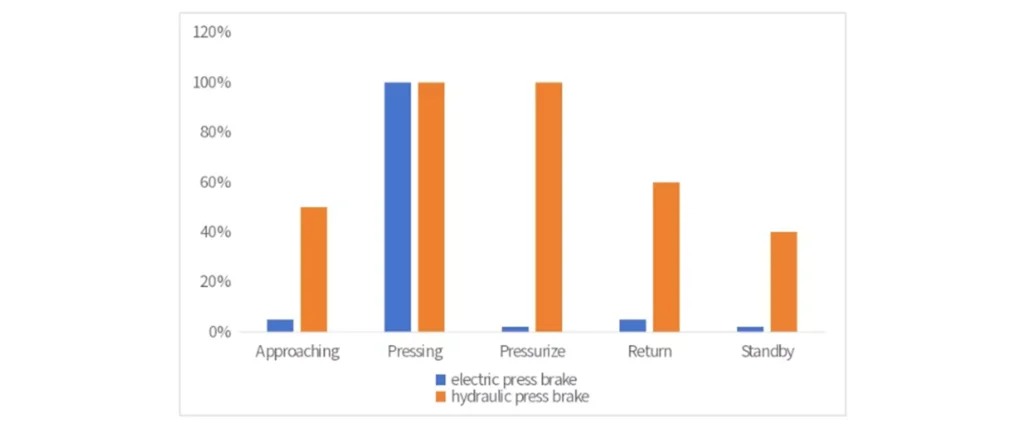
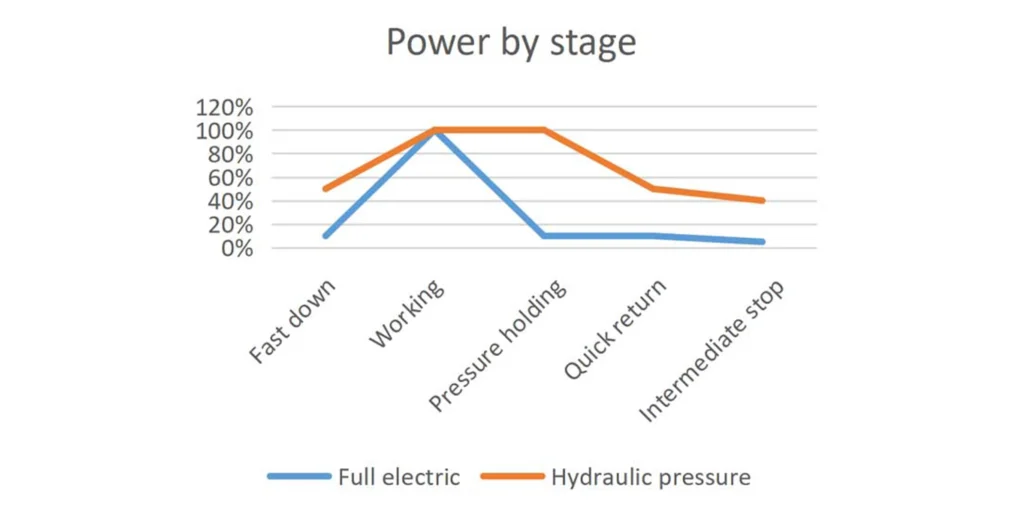
- The all-electric servo press brake consumes electricity similarly to an inverter air conditioner compared to a conventional one, automatically adjusting power output based on operating conditions for exceptional energy savings.
- Eliminates the need for hydraulic oil and its replacement, preventing environmental pollution from waste oil.
breadcrumbs
- Das servogetriebene System verbraucht Leistung proportional zur Last, wodurch der Energieverbrauch erheblich reduziert wird. Im Leerlauf des Schiebers wird nur minimale Leistung verbraucht, im Gegensatz zu Hydraulikmaschinen, die kontinuierlich Strom ziehen. Der Hauptübertragungswirkungsgrad übersteigt 95 %, verglichen mit weniger als 80 % bei Hydrauliksystemen, wobei der hydraulische Wirkungsgrad aufgrund von Alterung und Verschleiß weiter abnimmt.
- Der Verzicht auf Hydrauliköl macht Ölwechsel, die Wartung von Hydraulikkomponenten und die Beseitigung täglicher Öllecks überflüssig. Dies reduziert die Entsorgung von Altöl und die Umweltverschmutzung. Hohe Schiebergeschwindigkeiten und Produktionseffizienz tragen zusätzlich zu umweltfreundlichen Abläufen bei.
- Einstellbare Biegegeschwindigkeiten ermöglichen eine präzise Steuerung für unterschiedliche Materialstärken, -typen und Biegelängen und gewährleisten eine hohe Genauigkeit (±0,5° Winkelfehler) im Vergleich zu Hydraulikmaschinen (±1° Fehler). Das Direktantriebssystem erhöht die Übertragungspräzision, ohne kostspielige geschlossene Regelsysteme zu erfordern.
- Im Gegensatz zu Hydrauliksystemen, die regelmäßige Ölwechsel erfordern und anfällig für Pumpen-, Ventil- und Dichtungsfehler sind, verfügen rein elektrische Biegemaschinen über ein einfaches Übertragungssystem mit minimalem Wartungsaufwand, der sich typischerweise auf die regelmäßige Schmierung beschränkt.
Produktmerkmale:
CAMT rein elektrische Biegemaschinen liefern die doppelte Effizienz von Hydrauliksystemen und verbrauchen dabei nur die Hälfte der Energie.
CAMT wurde entwickelt, um den Marktanforderungen gerecht zu werden, und zeichnet sich durch leistungsstarke Funktionalität, umfangreiche integrierte Ressourcen sowie Merkmale wie Sicherheit, Effizienz, Energieeinsparung und Umweltfreundlichkeit aus.
Fortschrittliche Blechbiege- und Bewegungssteuerungsalgorithmen, wobei die Hauptplatine industrielle Chips verwendet. Das CNC-System hat die EMV-Prüfung zur elektromagnetischen Verträglichkeit und die Tests zur Umweltanpassungsfähigkeit bei hohen/niedrigen Temperaturen bestanden.
Vollelektrische Servo-Abkantpresse:
Zuverlässige Leistung, hohe Präzision bei hoher Geschwindigkeit, Energieeinsparung
setzt Hochgeschwindigkeits-Beschleunigungs-/Verzögerungs- und Trajektorien-Vorausschau-Algorithmen ein, die vor dem Biegeprozess vorab geplante Bewegungsbahnen basierend auf Biegegeschwindigkeit und Vektoreigenschaften ermöglichen. Dies gewährleistet optimale Biegepräzision und sanfte Bewegungseigenschaften bei Hochgeschwindigkeitsoperationen, wodurch hohe Geschwindigkeit effektiv mit hoher Genauigkeit integriert wird.
- Maximale Eilvorschubgeschwindigkeit der Y-Achse von 200 mm/s, maximale Arbeitsvorschubgeschwindigkeit von 30 mm/s.
- Wiederholpositioniergenauigkeit von ±0,01 mm.
- Eliminiert den Einfluss von Öl-Temperaturschwankungen auf die Konsistenz der gebogenen Werkstücke.
Außergewöhnlich energiesparend und umweltfreundlich
Die vollelektrische Servo-Abkantpresse verbraucht Strom ähnlich wie eine Inverter-Klimaanlage im Vergleich zu einer herkömmlichen, indem sie die Leistungsabgabe automatisch an die Betriebsbedingungen anpasst, um außergewöhnliche Energieeinsparungen zu erzielen.
Eliminiert die Notwendigkeit von Hydrauliköl und dessen Austausch, verhindert Umweltverschmutzung durch Altöl.